
NAVIGATING THE TEXAS MEDICAID FORMULARY:
A Comprehensive Guide for Pharmaceutical Manufacturers
The landscape of pharmaceutical product listing in Texas presents unique challenges for manufacturers seeking Medicaid coverage. Unlike other states, Texas operates its own Medicaid formulary, known as the Texas Drug Code Index (TDCI), which has a distinct submission process. While the traditional process of adding an NDC to Medicaid formularies involves updating pricing compendia and submitting data to CMS, Texas has additional steps. The state utilizes a web portal managed by Conduent to incorporate additional layers of validation.
This white paper provides crucial insights and a step-by-step guide for pharmaceutical manufacturers to successfully navigate the complexities of getting their NDCs approved for Medicaid coverage in Texas.
The Submission Process
Pharmaceutical manufacturers must adhere to a meticulous process to list their products on the Texas Medicaid Formulary. This involves updating pricing compendia such as FirstDataBank, Medispan, Redbook, Goldstandard, and Cerner Multum with new product information. Additionally, manufacturers must add their products to the Medicaid Drug Programs (MDP) system and submit data to both CMS and pricing compendia well in advance of product shipment to wholesalers. This preemptive step mitigates potential coverage issues and ensures timely formulary listing.
Users must register to use the Texas portal and submit a 1403 form each time they would like a new labeler added to their access permissions. They must then complete the Electronic Certificate of Information (eCOI) submission form, which includes inputting all drug information – NDC, name, strength, pack size, etc., and attaching an FDA approval letter, package insert(s), label image(s) and non-expired Certificate of Liability Insurance. The system generates a unique ID for the eCOI record, used for checking the status and making any changes if needed. When the NDC is initially input, the system does a validation against FirstDataBank. If it is not yet listed there, the system will not let you create the record. If it is, the ID is created. Typically, it only takes a day or two for products to be listed in the Compendium once the forms have been submitted and no corrections are needed.
After the eCOI has been completed, manufacturers can monitor the status of the listing, which ranges from 1st Review through Approval by the Texas Health and Human Services Commission (HHSC). The status can be checked anytime by logging onto Texas’ portal. Once the CMS Product file updates and the review process begins, users must watch for any emails saying the eCOI has been returned for corrections. When the product is approved, the user will be notified via email. They can then confirm the listing on the Formulary website – typically within a week.
Texas Timeline and Considerations:
Timing is paramount in the Texas Medicaid Formulary submission process. Manufacturers should initiate submissions promptly post-launch to accommodate the state’s review timeline. The review process, spanning up to 90 days, commences upon product listing on the CMS Product File. The CMS Product File shows all active products currently covered by Medicaid. It is only updated quarterly, following the submission of quarterly AMP data by drug manufacturers. Delays in Average Manufacturer Price (AMP) submissions or quarterly updates may prolong formulary listing until the subsequent year.
An example timeline for gaining access to the TX formulary for an NDC is below:
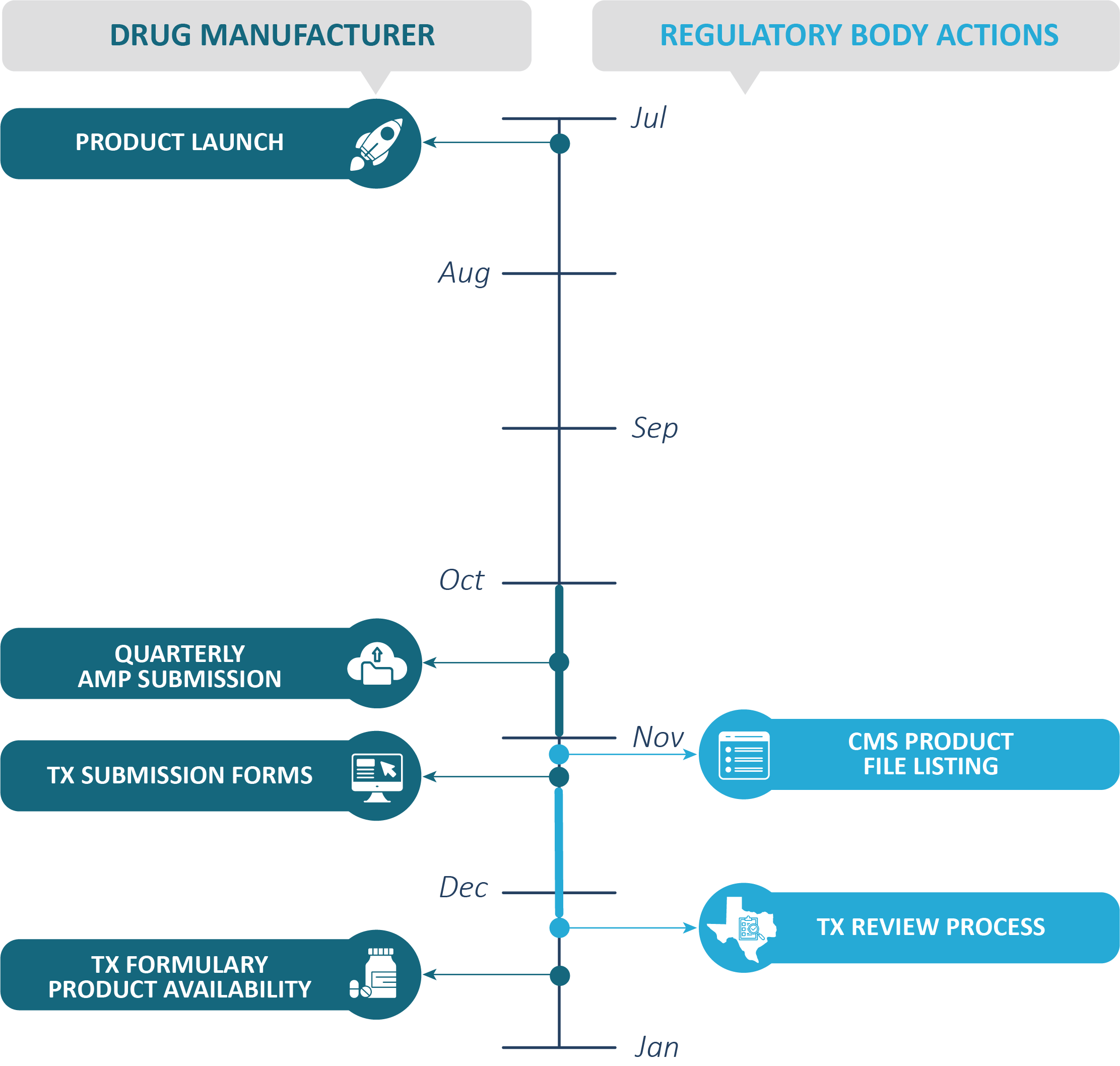
In this scenario, a product launched on July 1st may not be available on the TX formulary until mid-December or January the following year. This timeline may be reduced If the product launched at the end of the quarter, for example September 28th. In this revised scenario, the TX formulary launch would still be in December/January.
For Clinician-Administered Drugs (CAD), a distinct formulary exists, with listings based on CMS Product File updates. Manufacturers require no additional action for CAD listings, as the state automatically includes NDCs on the CAD Formulary. It is, however, important to make the TX CAD team aware of any such NDC and provide some information on the product to help expedite the process of these additions.
Texas Submission Rejections and Remediation:
Submissions may face initial rejection due to missing or incorrect information, or expired certificates of liability insurance. Manufacturers have 10 days to rectify initial eCOI submissions; failure to do so necessitates restarting the process. Product submissions may be denied for various reasons, including inactive CMS agreements or unsuitable product characteristics for formulary listing (e.g. unit dose, drug status COD 9 or 12, erectile disfunction products, etc.).
New in 2024:
Effective March 30, 2024, Texas announced a transition regarding the management of their online portal, which will then be overseen by Gainwell (replacing Conduent). As manufacturers await further details and assess potential impacts resulting from this change, we remain committed to keeping you informed and updated on developments.
Navigating the Texas Medicaid Formulary submission process demands diligence and adherence to timelines. Key differences in the Texas process, such as the utilization of a web portal and additional validation steps, necessitates careful attention and timeline management. By understanding these nuances and proactively engaging with the submission process, manufacturers can streamline formulary listings, ensuring access to essential medications for Texas Medicaid beneficiaries.

Dan Piergies
Chief Analytics Officer

Jenn Erickson
Director of Operations
Subscribe to receive our publications.
By signing up, you are agreeing with our privacy policy
Share this story, choose your platform.
If you’re looking for a long-term relationship with industry experts who are always available to help you leverage opportunities and mitigate threats, contact us today.
